
Executive Overview
In a decisive move that bridges the gap between the urgent global imperative for renewable energy and the localized necessity of wildlife conservation, the Kearney County Board of Commissioners in Nebraska has approved a landmark set of wind energy regulations. Enacted on Tuesday, August 18, 2026, these new rules are specifically designed to safeguard the world-renowned Sandhill Crane migration corridor along the Central Platte River.
The ordinance establishes a robust seven-mile setback restricting the development of large-scale wind energy infrastructure along the river’s northern boundary in Kearney County. This policy decision represents a major victory for conservationists, local business owners, and wildlife advocates alike. For months, local stakeholders, guided by scientific research and advocacy from organizations like the National Audubon Society’s Rowe Sanctuary, urged local leaders to recognize the deep symbiosis between ecological health and economic vitality in Central Nebraska.
By prioritizing science-based planning, Kearney County has demonstrated that the transition toward a clean energy future does not need to come at the expense of irreplaceable natural ecosystems. The region’s spring wildlife migration is not only a breathtaking ecological spectacle observed by hundreds of thousands of nature enthusiasts annually; it is also a powerful economic engine. Recent economic impact data indicates that the seasonal influx of visitors pumps approximately $28 million into the local economy each year, supporting hospitality, retail, and service sector jobs.
This comprehensive report explores the background of the Kearney County ordinance, details the months-long legislative journey, examines the scientific rationale and economic metrics underpinning the decision, and assesses what this precedent means for the broader future of renewable energy siting in the American Midwest.
Detailed Chronology: The Path to the August 2026 Ordinance
The journey toward establishing migration-friendly wind energy regulations in Kearney County was neither swift nor accidental. It was the product of an extended, multi-month civic dialogue involving county commissioners, agricultural landowners, local business leaders, and wildlife biologists.
Early Warning Signs and the Rise of Wind Development
As renewable energy targets accelerated nationwide over the past decade, the expansive, wind-rich plains of Nebraska increasingly caught the attention of commercial wind developers. While wind power offers an essential mechanism for cutting carbon emissions and combating climate change—which the Audubon Society identifies as the single greatest threat to North American bird species—the placement of turbines has frequently sparked localized debates.
In Kearney County, the intersection of prime wind resources and a globally significant ecological bottleneck created an immediate regulatory challenge. The county’s northern border is defined by the Platte River, a geographic lifeline for migratory birds. Recognizing the potential for friction between industrial wind infrastructure and avian flight paths, local officials realized they needed proactive zoning rules rather than ad-hoc conflict resolution.
Rowe Sanctuary’s Proactive Engagement
Beginning in early 2026, Audubon’s Rowe Sanctuary stepped forward as a key resource for the Kearney County Board of Commissioners. Rather than taking a purely adversarial stance against renewable energy, Rowe Sanctuary adopted an engagement strategy rooted in constructive dialogue and peer-reviewed science.
Throughout the spring and summer of 2026, sanctuary representatives participated actively in public comment sessions, town halls, and commissioner work sessions. They brought forward geographical data, behavioral studies on Sandhill Cranes, and comparative analysis of wind energy ordinances from neighboring jurisdictions. This months-long public engagement process ensured that local lawmakers had continuous access to empirical evidence regarding how industrial machinery impacts low-flying, highly sensitive bird species.
The Commission’s Deliberative Process
The Kearney County Board of Commissioners methodically weighed competing interests during the legislative process. Commissioners faced pressure from commercial energy developers eager to capitalize on the region’s transmission capacity, contrasted against passionate appeals from conservationists and tourism operators who argued that the county’s true economic identity is inextricably linked to the natural landscape.
By mid-summer, the discussion coalesced around specific geographical measurements. While initial developer proposals suggested standard setbacks that would have placed turbines dangerously close to the river valley, scientific data presented by Rowe Sanctuary altered the trajectory of the debate.
The Breakthrough Vote on August 18, 2026
On Tuesday, August 18, 2026, the long months of hearings, testimony, and scientific presentations culminated in a historic vote. The Kearney County Board of Commissioners formally approved the comprehensive wind energy regulations, enshrining a protective seven-mile setback from the Platte River. This vote marked a turning point in municipal planning for the region, setting a high standard for wildlife-conscious zoning in the American Great Plains.
Supporting Context & Metrics: Science, Economics, and Ecosystems
To fully understand the significance of the Kearney County ordinance, one must examine the unique ecological architecture of the Central Platte River Valley and the compelling economic realities that surround it.
The Ecological Significance of the Central Platte River
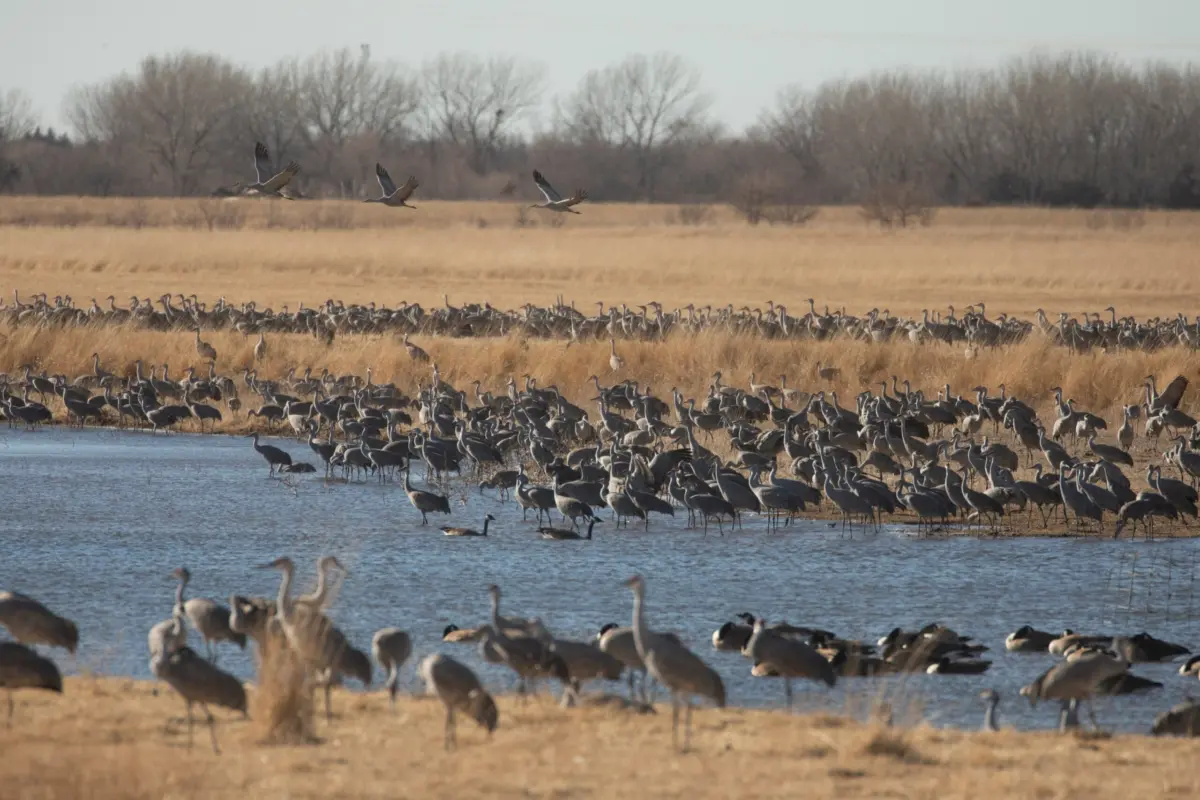
Each spring, the Central Platte River serves as the primary staging ground for the largest concentration of Sandhill Cranes on Earth. More than one million cranes—representing roughly 80 percent of the world’s population—funnel through this narrow ecosystem as they journey from their wintering grounds in the southern United States and Mexico to their breeding grounds in the Arctic and sub-Arctic.
For several weeks between February and April, the riverine landscape transforms. By day, the cranes disperse into surrounding agricultural fields to forage waste corn and macroinvertebrates. By night, they roost knee-deep in the shallow, braided channels of the Platte River, finding safety from land-based predators in the open water.
This fragile routine requires immense amounts of undisturbed energy acquisition. Disruptions to their daily movements can cause chronic stress, lower body condition, and ultimately reduce reproductive success.
The Three-Mile Behavioral Threshold and the Seven-Mile Solution
The scientific foundation for Kearney County’s new ordinance rests heavily on peer-reviewed avian research. Studies tracking Sandhill Crane behavior have consistently demonstrated that these birds regularly utilize upland habitats extending outward for roughly three miles from the Platte River corridor.
Crucially, behavioral research has also documented that cranes exhibit strong avoidance behaviors when confronted with tall vertical structures, such as commercial wind turbines and their associated transmission lines, within that same three-mile buffer zone. Turbines introduce visual motion, noise, and physical barriers that alter flight paths and force birds to expend precious metabolic energy flying around industrial zones or abandoning otherwise optimal foraging grounds.
When researchers combined these two metrics—habitat utilization extending three miles out and avoidance behaviors extending another three miles—the biological consensus pointed toward maintaining a minimum spatial buffer of at least six miles between the Platte River and any heavy wind energy infrastructure.
By pushing the regulatory boundary even further to establish a seven-mile setback, the Kearney County Board of Commissioners exceeded the baseline recommendation. This conservative buffer provides a vital margin of safety, ensuring that the cumulative footprint of future wind development will not inadvertently squeeze or degrade the ecological integrity of the river valley.
The Economic Engine of Ecotourism
While the moral and ecological arguments for conservation are potent, the economic rationale provided an equally compelling framework for local policymakers. Central Nebraska’s spring wildlife migration is not merely a scenic pastime; it is a multi-million-dollar economic driver.
A comprehensive economic impact study commissioned to evaluate the phenomenon revealed that the spring wildlife tourism season generates approximately $28 million annually for the regional economy. This influx of revenue directly supports a diverse network of local businesses, including:
- Hotels, motels, and bed-and-breakfast operations catering to bird-watchers and wildlife photographers.
- Restaurants, cafes, and local retail establishments experiencing seasonal surges in patronage.
- Specialized tour operators, educational centers, and conservation facilities employing local staff, educators, and guides.
When ecosystems thrive, local economies thrive in tandem. The Kearney County ordinance protects this economic foundation by ensuring that the landscape remains pristine, rural, and uniquely attractive to travelers seeking authentic encounters with North American wildlife.
Official Statements and Stakeholder Perspectives
The passage of the Kearney County ordinance has drawn widespread praise from environmental groups, regional agricultural leaders, and community planners. It is viewed not as an anti-development measure, but as a sophisticated framework for smart growth.
Rowe Sanctuary and the National Audubon Society
Leaders at Audubon’s Rowe Sanctuary expressed profound gratitude for the foresight demonstrated by local officials.
"At Rowe Sanctuary, we say that conservation succeeds when people come together around shared values. This decision is a positive example of that principle in action," noted organizational spokespersons following the August 18 vote. "We are grateful to the Board of Commissioners for engaging the public, considering the best available science, and taking steps to protect a natural wonder."
Significantly, Rowe Sanctuary’s active participation in the Kearney County zoning process aligns seamlessly with the National Audubon Society’s broader national platform on clean energy. Audubon strongly supports the rapid transition to renewable energy sources, recognizing that global climate change poses an existential threat to hundreds of North American bird species through habitat loss, shifting weather patterns, and extreme heat events.
However, Audubon’s clean energy policy emphasizes responsible siting. The organization advocates for a balanced approach that deploys renewable infrastructure aggressively while deliberately avoiding high-value, irreplaceable ecological zones. The Kearney County regulations are being held up by conservation analysts as a textbook example of this principle manifested at the local government level.
Local Governance and Community Voice
The Board of Commissioners’ willingness to listen to multi-stakeholder input—balancing the concerns of agricultural landowners, wind energy representatives, and wildlife biologists—has been widely commended. By keeping channels of communication open over the multi-month deliberation period, the county fostered a sense of shared ownership over the final ordinance.
Agricultural producers within Kearney County, many of whom lease land for agricultural production while also benefiting from the economic spillover of local tourism, found reassurance in clear, predictable zoning guidelines. The seven-mile setback establishes legal clarity, eliminating ambiguity for landowners considering renewable energy leases while safeguarding the visual and environmental heritage of the Platte River valley.
Future Outlook: A Blueprint for the American Great Plains
As the United States continues its rapid buildout of wind, solar, and transmission infrastructure, the tension between land use and wildlife preservation will inevitably surface in other rural counties across the Midwest and West. The Kearney County precedent offers a vital roadmap for how communities can navigate these complex dilemmas.
Replicating Success Across the Central Flyway
The Central Platte River is just one critical node in the broader Central Flyway, a migratory superhighway utilized by millions of waterfowl, shorebirds, and raptors every year. As developers scout wind-swept tracts stretching from Texas to the Dakotas, local governments face mounting pressure to draft sensible zoning codes.
The Kearney County model proves that rural counties do not need to choose blindly between economic development and environmental stewardship. By grounding municipal policy in rigorous, peer-reviewed science—such as the three-mile utilization and avoidance thresholds—local leaders can craft defensible, transparent regulations that protect sensitive wildlife corridors without stalling regional economic progress.
The Ongoing Imperative of Adaptive Management
Conservationists emphasize that passing an ordinance is merely the first step. Long-term success will require ongoing monitoring, collaboration between landowners and conservation groups, and adaptive management as technology evolves. As taller, higher-capacity wind turbines emerge on the market, future county boards will need to remain vigilant, ensuring that technological advancements do not inadvertently expand the effective footprint or ecological disturbance zone of modern energy infrastructure.
A Legacy for Future Generations
Ultimately, the Kearney County wind energy regulations speak to a deeper cultural and generational responsibility. The Sandhill Crane migration is an ancient natural spectacle, predating modern agriculture, municipal boundaries, and industrial energy systems alike.
By establishing a protective seven-mile buffer along the Central Platte River, the Kearney County Board of Commissioners has ensured that the haunting, prehistoric calls of cranes echoing across the spring meadows will not be silenced by the hum of industrial turbines. It is a testament to the fact that when communities unite around shared values of stewardship and scientific reason, they can build a future where clean energy and natural wonders endure side by side.