
Executive Overview
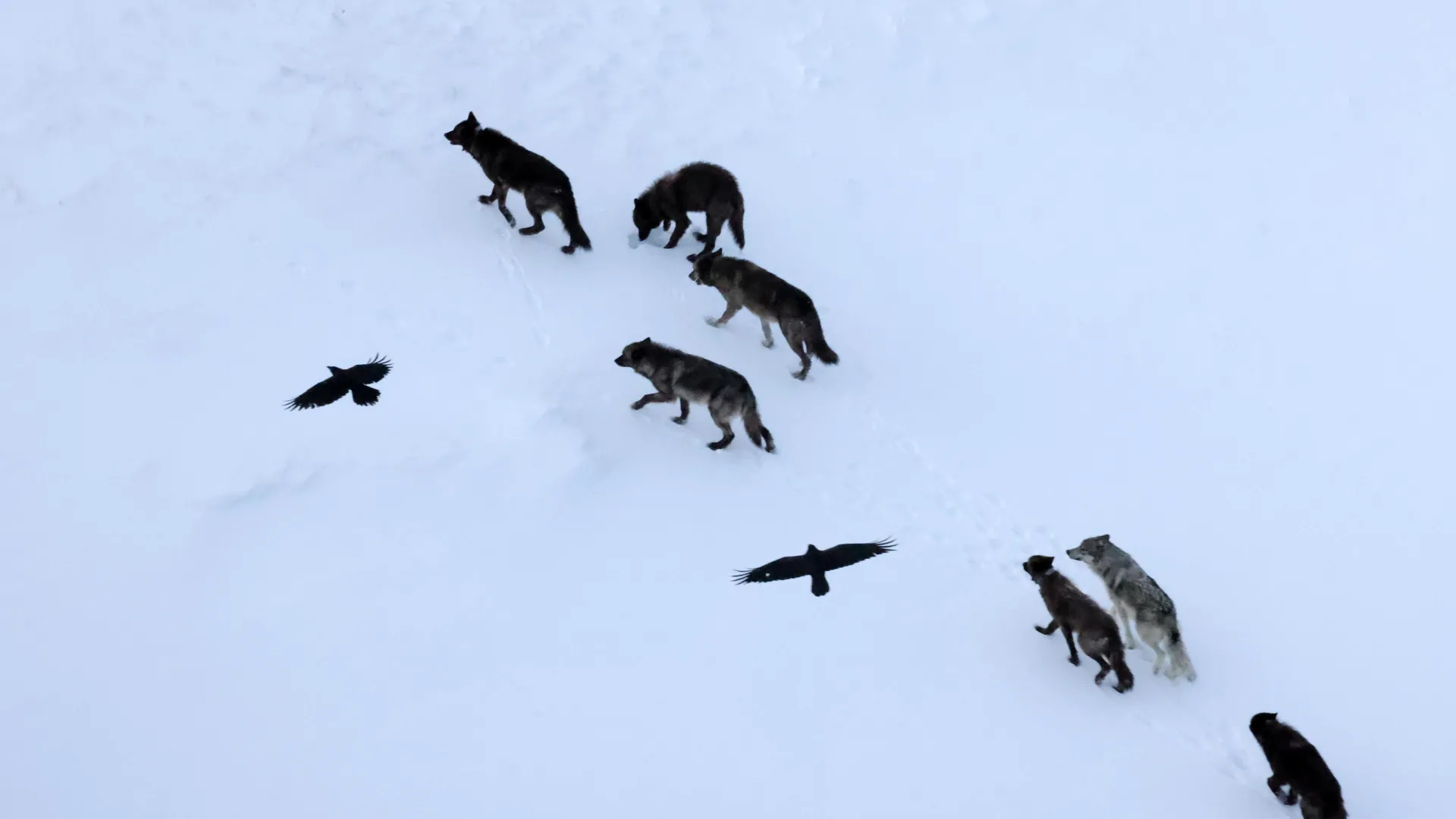
For generations, the synchronized choreography between gray wolves (Canis lupus) and common ravens (Corvus corax) has been a staple of wilderness lore. When a wolf pack brings down a massive elk or bison in the rugged expanse of North America, ravens seem to materialize out of thin air. Even before the exhausted predators can settle in to feed, these glossy-black corvids gather in the surrounding pines, pacing the snow and waiting to snatch high-energy scraps.
For decades, the ecological assumption was straightforward: ravens survive the brutal winters of ecosystems like Yellowstone National Park by tethering themselves to wolf packs. Conventional wisdom held that the birds acted as aerial shadows, tailing the predators step-for-step to secure a guaranteed meal. It was a neat, uncomplicated narrative of ecological dependency.
Now, a comprehensive, multi-year study published in the prestigious journal Science has shattered that long-held assumption, revealing a strategy far more cognitively advanced than previously imagined. Rather than enduring the exhausting enterprise of trailing wolves across miles of punishing terrain, ravens are playing a much more sophisticated game. Armed with exceptional spatial memory and formidable navigational skills, these birds map the landscape, remembering historical kill zones and returning to them from distances spanning up to 155 kilometers in a single day.
By tracking 69 ravens and 20 wolves over two and a half years in Yellowstone, an international consortium of researchers has rewritten our understanding of avian intelligence and scavenger-predator ecology. The findings prove that ravens do not need to constantly shadow wolves to profit from them. Instead, they rely on an internalized "resource map," utilizing cognitive cartography to outwit, out-maneuver, and out-locate their mammalian counterparts.
Detailed Chronology: Unraveling the Myth of the Shadowing Scavenger
The path to this paradigm-shifting discovery required unprecedented technological deployment and years of rigorous fieldwork in one of the world’s most dynamic wilderness laboratories.
The Reintroduction of Yellowstone’s Apex Predators
To understand the intricate relationship between wolves and ravens, one must first look back to the mid-1990s, when gray wolves were reintroduced to Yellowstone National Park after a 70-year absence. The return of the apex predator radically reshaped the park’s ecology, triggering a cascading effect known as a trophic cascade. For scavengers like ravens, the return of wolves meant a massive, reliable influx of carrion—free meals provided by apex hunters who rarely consumed every ounce of heavy-boned prey, especially during harsh winters.
For years, biologists observed the close spatial and temporal association between the two species. Dr. Dan Stahler, a Yellowstone wildlife biologist who has dedicated decades to studying the park’s wolves, watched this dynamic play out countless times. "You see them flying directly above traveling packs or hopping close behind wolves as they take down prey," Stahler notes. Because the behavioral cues were so consistent, scientists naturally assumed the relationship was governed by a simple rule: stick close to the wolves. Yet, due to logistical hurdles and the elusive nature of both species, this hypothesis had never been rigorously tested from the perspective of the scavenger.
Designing the Ultimate Tracking Experiment
To properly evaluate the cognitive mechanics of raven foraging, an elite team of researchers from the Research Institute of Wildlife Ecology at the University of Veterinary Medicine Vienna, the Max Planck Institute of Animal Behavior, and several international institutions devised a massive tracking initiative.
Capturing ravens for GPS tagging is notoriously difficult. These corvids possess legendary caution and neophobia—an innate fear of new things in their environment. "Ravens are so observant of the landscape that they don’t step into traps easily," explains Dr. Matthias Loretto, the study’s first author. To bypass this acute wariness, the research team had to outthink the birds. Traps set near human-use areas like campsites were meticulously disguised with urban debris, trash, and fast-food wrappers. "Or else the ravens would suspect that something was off and wouldn’t come near it," Loretto recalls.
Ultimately, the team successfully fitted 69 ravens with miniature, high-precision GPS tracking devices—an extraordinarily large sample size for an avian tracking study of this magnitude. Simultaneously, movement data was collected from 20 wolves equipped with telemetry collars.
The primary phase of data collection zeroed in on winter, the season when raven-wolf interactions peak and food stress is at its highest. Researchers logged raven locations every 30 minutes, while wolf movements were recorded hourly. GPS coordinates were cross-referenced with precise field documentation of where and when wolves successfully hunted elk, bison, and deer.
The Plot Twist: Shifting the Paradigm
When the immense volume of movement data was finally compiled and analyzed, the research team encountered a startling anomaly. Over two and a half years of continuous monitoring across hundreds of square kilometers, researchers documented only one clear instance of a raven following a wolf for more than one kilometer or for longer than an hour.
"At first, we were puzzled," admits Loretto. "Once we realized that ravens are not following wolves over long distances, we couldn’t explain why the birds still arrive so quickly at wolf kills."
The traditional narrative was crumbling in real-time. If ravens were not shadowing wolves across the snowscapes of Yellowstone, how were they managing to arrive at fresh kills so reliably, often beating back-country scavengers to the scene?
A deeper dive into the tracking logs revealed the astonishing reality: the ravens were not reacting to the wolves; they were reacting to the landscape.
Rather than trailing predators, individual ravens repeatedly flew in direct, purposeful paths toward specific geographic sectors where kills historically clustered. Some birds covered up to 155 kilometers in a single day, soaring across mountain ranges and valleys straight to locations where a carcass was statistically likely to materialize. They did not know the exact minute a wolf would strike, but they knew where the hunting grounds were most fertile.
Supporting Context & Metrics: The Science of the Resource Landscape
The mechanics behind the ravens’ success lie in their ability to master what researchers term a long-term "resource landscape."
The Spatial Geography of Predation
Wolf hunting efficiency is not uniform across an ecosystem. In Yellowstone, successful wolf kills are heavily concentrated in specific topographic niches, such as flat valley bottoms, open meadows, and low-elevation riparian zones where ungulates congregate during harsh winter weather and where pack tactics have a higher probability of success.
While a single kill event is inherently stochastic—random and unpredictable in timing—the macro-pattern of predation is remarkably stable over space and time. Valley bottoms and historical migratory bottlenecks consistently yield more carrion than steep, heavily forested mountain slopes.
- Spatial Memory vs. Real-Time Tracking: While landfills and human settlements represent fixed, static food sources that ravens have long been known to memorize, biological kills are dynamic. Ravens demonstrate an advanced cognitive leap by mapping probabilistic biological hotspots rather than static garbage dumps.
- Flight Capabilities: Capable of sustained, non-stop flight for up to six hours, a raven can traverse vast territories with minimal metabolic expenditure. "They can fly six hours non-stop, straight to a kill site," emphasizes Loretto.
- Scale-Dependent Strategies: The study reveals a dual-layered behavioral model. On a macro-scale (tens to hundreds of kilometers), ravens rely purely on spatial memory, targeting high-yield landscape sectors. On a micro-scale (when they are already in the vicinity), they switch to sensory and social cues—such as monitoring direct wolf body language, spotting circling corvids, or listening to distant wolf howls—to pinpoint the exact location of a fresh carcass.
Official Statements and Expert Perspectives
The publication of this study in Science has sent ripples through the ornithological and ecological communities, prompting a re-evaluation of corvid intelligence and the evolutionary pressures shaping scavenger behavior.
Dr. Matthias Loretto, the study’s lead author, underscores the elegance of the birds’ navigational strategy:
"Ravens can cover large distances by flying, and they seem to have a good memory, so they don’t need to constantly follow wolves in order to profit from the predators. We already knew that ravens can remember stable food sources, like landfills. What surprised us is that they also seem to learn in which areas wolf kills are more common. A single kill is unpredictable, but over time some parts of the landscape are more productive than others—and ravens appear to use that pattern to their advantage."
Dr. Dan Stahler, Yellowstone National Park biologist, reflects on the humility required in field science:
"We all assumed that the birds had a very simple rule; just stick close to the wolves. But we didn’t know what ravens were capable of because nobody had ever put them at the center; nobody had taken the scavenger’s point of view."
Prof. John M. Marzluff of the University of Washington, a senior author on the project and a globally recognized authority on corvid behavior, highlights the broader implications of the research:
"What our study clearly shows is that ravens are flexible in where they decide to feed. They don’t stay tied to a particular wolf pack. With their sharp senses and memory of past feeding locations, they can choose among many foraging opportunities far and wide. This changes how we think about how scavengers find food—and suggests we may have underestimated some species for a long time."
Future Outlook: Implications for Conservation and Behavioral Ecology
The revelation that ravens operate as cognitive cartographers rather than simple dependent shadows opens exciting new avenues for behavioral ecology and wildlife conservation.
Rethinking Avian Cognition
For decades, studies of animal intelligence have often prioritized tool-use in primates or vocal learning in cetaceans and songbirds. This research firmly places corvids—specifically common ravens—in the upper echelon of cognitive powerhouses, capable of mental time travel, spatial mapping, and probabilistic risk-reward analysis across expansive geographical scales. The ability to integrate historical memory with real-time sensory inputs over a territory spanning hundreds of square kilometers requires a neurological architecture comparable to that of many large mammals.
Ecosystem Management in Yellowstone
Understanding the true dynamics of scavenging networks is vital for managing complex ecosystems like Yellowstone. Carcasses provided by wolves do not merely feed ravens; they support an entire guild of obligate and facultative scavengers, including bald eagles, golden eagles, coyotes, and grizzly bears. By mapping how primary scavengers like ravens navigate this network, conservationists gain a clearer picture of energy flow and nutrient cycling across protected landscapes.
Next Frontiers in Tracking Technology
As telemetry technology continues to shrink in weight while expanding in battery life and data resolution, researchers plan to apply similar multi-species tracking frameworks to other ecosystems. Future studies may investigate whether juvenile ravens—which lack the lifetime of accrued spatial memory possessed by adults—rely more heavily on shadowing wolves before graduating to independent, memory-based navigation.
Ultimately, the Yellowstone raven study serves as a humbling reminder of the complex, hidden layers of the natural world. Beneath the glossy feathers of a roadside scavenger lies a mind capable of mental cartography, transforming the raw wilderness into an intuitive, memorized map of survival.