
By Whitney Hummel, Lee Barrier Islands Anchor Steward
Published by Special Environmental Report Desk
Executive Overview
To millions of tourists and residents, Florida’s pristine sandy coastline represents the ultimate weekend getaway—a dynamic landscape of sun, surf, and leisure. However, beneath the umbrellas and beach towels lies a fragile, high-stakes ecosystem. For nearly half the year, from February through August, Florida’s beaches transition from recreational zones into critical maternity wards. This six-month stretch marks the annual shorebird nesting season, a period of extraordinary vulnerability for species that rely exclusively on the open sand to lay their eggs, incubate clutches, and rear their flightless chicks.
In recent years, the intersection of booming coastal development, rising tourism, and wildlife conservation has created an increasingly tense balancing act. Organizations like Audubon Florida, alongside dedicated local anchor stewards, deploy every resource possible to safeguard these habitats. Yet, human disturbance remains an existential threat. Simple, seemingly harmless actions—stepping past a warning rope for a shortcut, letting a friendly dog off-leash, or flushing a flock of birds for a photograph—can spell disaster for imperiled populations.
This comprehensive report examines the biological realities of Florida’s shorebird nesting season, the severe legal framework protecting these migratory and resident species, the vital role of community stewardship, and the actionable steps beachgoers must take to ensure that human recreation and wildlife survival can coexist along the Sunshine State’s legendary shores.
Detailed Chronology: The Lifecycle and Vulnerabilities of Beach-Nesting Birds
Understanding the urgency of coastal conservation requires a closer look at the species that call Florida’s beaches home and the temporal milestones of their breeding cycle.
[February] ──> [April-May] ──> [June-July] ──> [August]
  Nesting        Peak Egg       Chic-Rearing     Season
  Begins        Incubation       & Fledging      Concludes
The Players on the Sand
Florida’s shorebird community includes a diverse mix of permanent residents and long-distance migrants. Among the most prominent species are:
- Snowy Plovers (Charadrius nivosus): Tiny, pale-feathered shorebirds that blend seamlessly into light coastal sands.
- Wilson’s Plovers (Charadrius wilsonia): Recognized by their heavy bills, specialized for feeding on fiddler crabs.
- American Oystercatchers (Haematopus palliatus): Striking birds with bright orange-red bills and bold black-and-white plumage.
- Least Terns (Sternula antillarum): North America’s smallest breeding tern, known for colonial nesting and aggressive aerial defense of their territories.
- Black Skimmers (Rynchops niger): Distinctive colonial waterbirds featuring a lower mandible significantly longer than the upper, used to skim the water’s surface for fish.
Phase 1: Establishment and Courtship (February – March)
As winter transitions into spring, coastal temperatures rise, signaling the beginning of the breeding season. Pairs form territories on the high-energy sandy beaches, typically above the normal high-tide line. Unlike songbirds that build elaborate cup-shaped nests in trees, most beach-nesting shorebirds create "scrapes"—shallow depressions scratched directly into the sand, shell fragments, or wrack lines.
Phase 2: Incubation and the Threat of Thermal Stress (April – May)
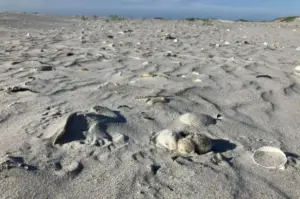
Once eggs are laid (usually clutches of two to three), the real test of endurance begins. Both male and female adults take turns incubating the eggs. However, shorebird eggs are marvels of natural camouflage, speckled to mimic the surrounding shell grit and sand. This makes them extraordinarily difficult for beachgoers to spot, but it also renders them hyper-vulnerable to accidental crushing.
Furthermore, thermal regulation is a life-or-death issue. If a human or a domestic animal approaches too closely, the adult bird will become startled and "flush" (flee) from the nest. In Florida’s punishing spring and summer sun, unincubated eggs can reach lethal internal temperatures within mere minutes. A few minutes away from the nest under direct solar radiation can cook an embryo, destroying the next generation before hatching even occurs.
Phase 3: Hatching and Rearing (June – July)
Shorebird chicks are precocial, meaning they hatch fully feathered, with open eyes, and are capable of walking and feeding within hours of birth. Unlike nest-bound songbirds, these chicks wander across the sand alongside their parents to forage for small invertebrates.
Because they cannot fly for the first several weeks of their lives, running away from danger is their primary defense mechanism. When exhausted by repeated disturbances—such as being chased by beachgoers, children, or unrestrained dogs—chicks expend vital energy needed for growth, or they become separated from their parents, leading to rapid mortality from exposure, dehydration, or predation.
Phase 4: Fledging and Departure (August)
By late summer, surviving chicks achieve "fledge" status, developing the flight feathers necessary to take to the air. The adult birds and their offspring begin to congregate in larger flocks, preparing for post-breeding dispersal or long-distance southward migration. The nesting season officially draws to a close, leaving conservationists to evaluate population metrics and prepare for the cycle to begin anew.
Supporting Context & Metrics: The Human and Environmental Impact
To contextualize the pressure on Florida’s shorelines, conservation scientists track several interconnected variables, ranging from population declines to behavioral psychology on the beach.
The Ecological Cost of Disturbance
Research conducted by organizations like Audubon Florida demonstrates a direct correlation between high human foot traffic and reproductive failure in shorebird colonies.
- The "Flush" Response Metric: When an adult bird is flushed from its nest more than three times an hour, overall incubation efficiency drops by over 40%.
- Predation Magnification: Disturbed birds spend up to 60% more time engaging in anti-predator defense and stress behaviors, leaving them less time to forage. Concurrently, human food waste left on beaches—such as unsecured garbage, fish scraps, and discarded picnic items—attracts opportunistic predators like raccoons (Procyon lotor), crows (Corvus brachyrhynchos), and foxes. These urban-adapted predators raid shorebird nests, consuming eggs and chicks at unprecedented rates.
The Canine Factor
Many well-meaning beachgoers believe that bringing a friendly, well-behaved dog to the beach is harmless. However, behavioral biology dictates otherwise.
- The Predator Paradox: Wildlife cannot differentiate between a domestic pet dog and a natural mammalian predator like a coyote (Canis latrans). To a nesting Snowy Plover or Least Tern, an approaching dog represents an immediate, mortal danger.
- Colony Panic: A single loose dog running through a nesting zone can trigger a mass abandonment of dozens of nests simultaneously, leaving hundreds of exposed eggs vulnerable to heat and gulls.
Official Statements and Legal Framework
Florida’s imperiled beach-nesting birds do not merely rely on public goodwill; they are backed by rigorous state and federal statutes designed to prevent harassment, injury, and habitat destruction.
State Designations and Protections
The Florida Fish and Wildlife Conservation Commission (FWC) categorizes several coastal nesting species under strict conservation brackets:
- State-Designated Threatened Species: American Oystercatcher, Snowy Plover, Least Tern, and Black Skimmer.
- Candidate Species: Wilson’s Plover, which is currently undergoing evaluation for the same stringent state-level protections.
Under Florida law, intentionally killing, wounding, or possessing a state-designated threatened species—or intentionally destroying its nests or eggs—constitutes a third-degree felony. These violations carry severe financial penalties and potential prison sentences, underscoring the state’s zero-tolerance policy for willful wildlife harassment.
Federal Enforcement: The Migratory Bird Treaty Act (MBTA)
Because many of these shorebird species migrate across international borders, they fall under the jurisdiction of the federal Migratory Bird Treaty Act of 1918.
- Misdemeanor Violations: Unauthorized "taking," capturing, or killing of a protected migratory bird can result in fines of up to $15,000, imprisonment for up to six months, or both.
- Felony Violations: Knowingly taking a migratory bird with the intent to sell or barter it, or engaging in commercial trafficking of protected species parts, is categorized as a federal felony punishable by fines up to $2,000 and up to two years in federal prison.
The Voice of Stewardship
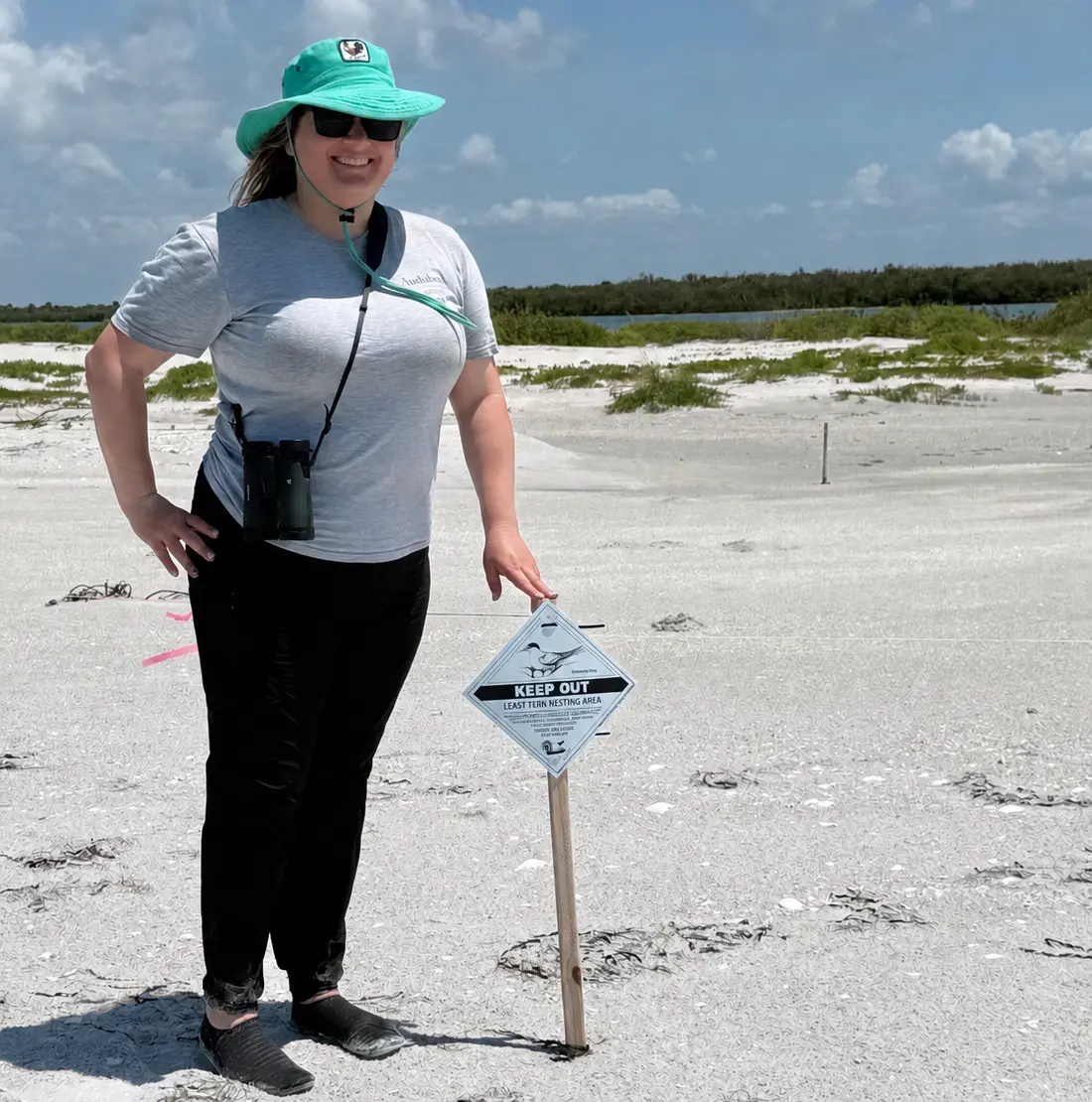
Audubon anchor stewards serve as the frontline diplomats between the public and the wildlife. Whitney Hummel, Lee Barrier Islands Anchor Steward, emphasizes the importance of education over confrontation:
"When people see a roped-off nesting zone, the temptation is often to look for a quick shortcut. They don’t realize that stepping past those stakes can destroy months of preparation for a pair of birds. Our goal as stewards is to bridge that gap in understanding. The birds themselves are incredible communicators—when a Least Tern begins dive-bombing your head or a Wilson’s Plover performs a broken-wing display, they are telling you in no uncertain terms that you have entered their sanctuary. We are simply here to translate that message and remind the public that our coastlines are shared spaces."
Future Outlook: Coexistence on a Crowded Coastline
As Florida’s human population continues to surge—with hundreds of new residents arriving daily—the pressure on remaining natural coastal habitats will only intensify. Ensuring the survival of species like the Snowy Plover and Black Skimmer requires a proactive, community-wide shift in how we approach coastal recreation.
Actionable Guidelines for Beachgoers
Protecting shorebirds does not require closing the beaches to human enjoyment. Instead, it requires mindful behavioral adjustments:
- Respect Boundaries: Never cross ropes, stakes, or caution tape marking posted shorebird nesting zones. If you encounter birds outside these zones, give them a wide berth—walk around flocks rather than through them.
- Watch for Behavioral Cues: If birds become visibly agitated, emit loud alarm calls, or begin dive-bombing, you are too close. Back away slowly until the birds calm down.
- Leash and Localize Dogs: Keep pets entirely away from posted nesting areas, and obey local ordinances regarding leash laws on public beaches.
- Practice Leave-No-Trace Principles: Pack out all garbage, food scraps, and packaging. Secure trash in wildlife-proof receptacles to prevent subsidizing populations of natural predators like raccoons and crows.
- Ditch the Drone: Never fly unmanned aerial vehicles (drones) near nesting colonies. Drones are frequently mistaken for avian predators like large hawks or eagles, causing immediate panic and mass nest abandonment.
The Ultimate Takeaway
For a human beachgoer, walking around a posted nesting boundary or taking a slightly longer route down the strand involves nothing more than a few extra steps. For a nesting shorebird, those exact same steps can mean the difference between successful parenthood and total reproductive failure during the most critical window of its life.
By embracing shared stewardship, respecting wildlife laws, and honoring the biological realities of Florida’s coastal ecosystems, we can ensure that future generations of both humans and shorebirds will continue to thrive together along the sun-drenched shores of the Sunshine State.