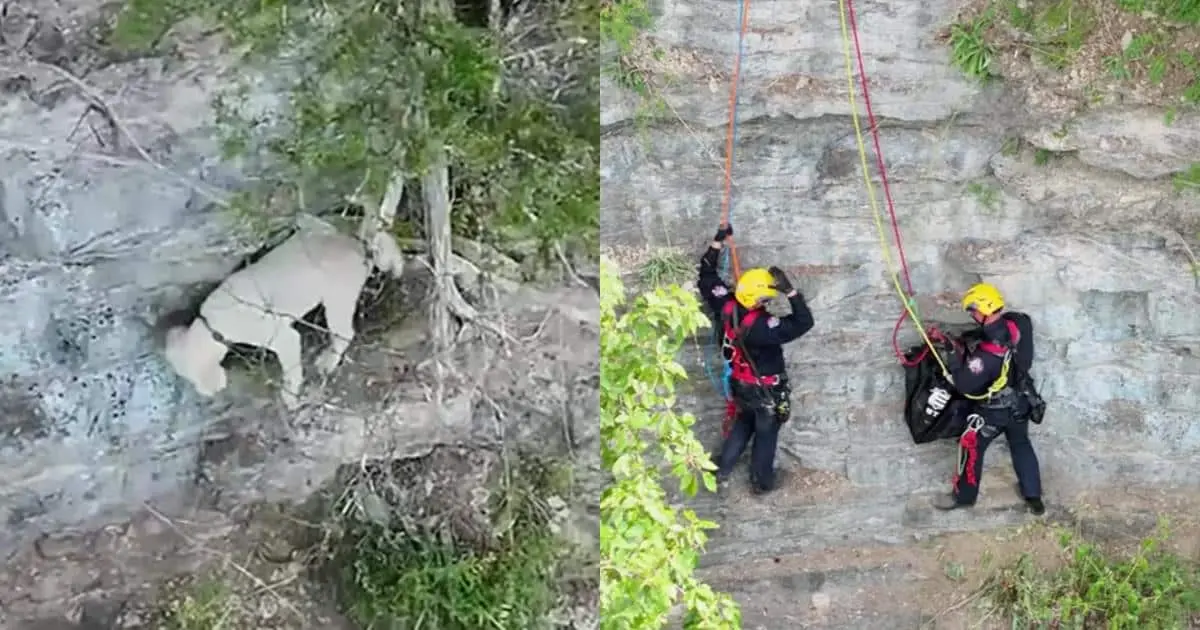
In the rugged terrain of Dickson County, Tennessee, a highly coordinated, multi-agency rescue operation successfully recovered a five-year-old Lagotto Romagnolo named Carl from a sheer cliff face. The canine had fallen approximately 120 feet down a 200-foot bluff, landing on a precarious, narrow ledge where he remained stranded for nearly 17 hours. The incident, which began as a routine recreational outing on a private farm off Timber Ridge Road, quickly escalated into a complex technical rescue requiring advanced drone reconnaissance, high-angle rope systems, and the mobilization of four distinct fire departments.
Beyond its technical complexity, the rescue highlights the profound intersection of community-driven volunteerism and professional emergency services. For the dog’s owner, Scott Grissom—a widower who lost his wife in recent years—Carl represents a vital emotional lifeline. The successful extraction of the 30-pound canine without major injuries is being hailed by local officials as a testament to the efficacy of modern search-and-rescue (SAR) protocols, inter-departmental synergy, and the strategic deployment of civilian technology.
Detailed Chronology
[Thursday, 5:00 PM] --- Outing begins at Timber Ridge Road farm
[Thursday, 5:45 PM] --- Carl goes missing near the scenic overlook
[Thursday, 6:00 PM] --- Owner hears vocalizations from the bluff below
[Thursday, 9:00 PM] --- Neighbor Bert Echols deploys reconnaissance drone
[Friday, 2:00 AM]   --- Drone successfully locates Carl on a ledge (120 ft down)
[Friday, 8:00 AM]   --- Four local fire departments arrive on-scene
[Friday, 9:30 AM]   --- High-angle rope rescue system is rigged and deployed
[Friday, 10:15 AM]  --- Rescuers reach Carl; canine secured in transport bag
[Friday, 11:00 AM]  --- Carl is hauled to safety; emotional reunion with owner
The Disappearance and Initial Discovery
On the late afternoon of Thursday, Scott Grissom and his companion, Carl, visited a friend’s expansive agricultural property off Timber Ridge Road in Dickson County. The afternoon was typical of their outdoor excursions, with Carl—a highly active, 30-pound Lagotto Romagnolo—swimming in a nearby creek and socializing with other dogs.
As the sun began to set, the group hiked toward a scenic lookout point overlooking Jones Creek, a waterway flanked by sheer limestone bluffs. At approximately 5:45 PM, as the party prepared to depart, Grissom realized Carl was no longer with the group. After roughly ten minutes of intense searching and vocal calling, the searchers heard faint, distressed vocalizations echoing from the chasm below. Grissom realized with immediate horror that Carl had slipped over the edge of the vertical bluff.
The Midnight Aerial Search
Due to the sheer drop and dense undergrowth, direct physical inspection of the cliffside was impossible without specialized equipment. As night fell, local terrain hazards prevented immediate foot descent. At approximately 9:00 PM, neighbor Bert Echols arrived on-scene with a high-definition civilian drone.
Echols piloted the aircraft through the narrow, tree-lined gorge under cover of darkness, utilizing the drone’s camera system to scan the rocky crevices of the limestone wall. The aerial search continued for five grueling hours. At approximately 2:00 AM Friday, the drone’s camera captured a positive visual confirmation: Carl was alive, huddled on a narrow, rocky outcrop adjacent to a shallow cave, approximately 120 feet below the cliff’s rim and 80 feet above the boulder-strewn banks of Jones Creek.
The Multi-Agency Morning Extraction
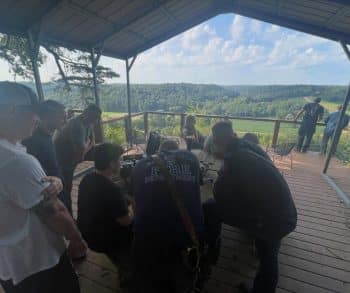
With the precise coordinates and physical state of the canine confirmed, emergency services were mobilized at dawn on Friday. Responders met at the staging area on Timber Ridge Road to formulate an extraction plan.
          [CLIFF TOP]  o--- (Anchors & Haul System)
                      |
                      |  ~ 120 Feet Descent
                      |
                      v
             [LEDGE] [Dog Located Here]
                      |
                      |  ~ 80 Feet remaining to Jones Creek
                      |
                      v
         [CREEK BED] ~~~~~~~~~~~~~~~~~~~~~
By 8:00 AM, a specialized task force had assembled, comprising personnel from:
The City of Dickson Fire Department (including their elite Special Operations Response Team)
Ashland City Fire Department
Charlotte Fire Department
Harpeth Ridge Fire Department
Using the drone imagery from the night before, technical rescue specialists mapped out a vertical descent path. The Dickson Fire Special Operations Response Team constructed a high-angle rope rescue system, utilizing multi-point anchors secured to robust natural features and specialized vehicles at the cliff’s edge.
At approximately 9:30 AM, a designated climber began the slow, metered descent down the sheer 70-foot vertical wall, followed by a second steep, unstable slope to reach the ledge. Upon the rescuer’s arrival at the ledge, Carl did not retreat or exhibit defensive aggression. Instead, the exhausted canine immediately moved toward the responder, allowing himself to be secured. The rescue team placed Carl inside a heavy-duty, reinforced duffel bag designed for secure vertical transport.
At approximately 11:00 AM, the haul team at the cliff’s summit operated a mechanical advantage pulley system to lift the rescuer and Carl back to safety.
Supporting Context & Metrics
The Physics of the Location
The bluffs overlooking Jones Creek in Dickson County are part of the Western Highland Rim geologic region, characterized by highly weathered Mississippian-era limestone. These formations present significant hazards for technical rescue operations:
Metric
Measurement / Specification
Total Cliff Height
~200 feet
Canine Landing Depth
~120 feet below rim
Upper Section Profile
70-foot vertical sheer rock face
Lower Section Profile
Steep, unstable talus slope
Rescuer Headcount
9 active personnel (plus support staff)
Total Stranded Duration
~17 hours
High-angle rope rescue is defined operationally as any terrain slope exceeding 60 degrees, where the rescue load is entirely dependent on the rope tension system rather than the physical footing of the rescuer. The presence of loose limestone shale and overhanging vegetation required the deployment of edge-protection systems to prevent rope abrasion and rockfall hazards.
Breed Characteristics: The Lagotto Romagnolo
The survival of the canine is partially attributed to the physical characteristics of his breed. The Lagotto Romagnolo is an ancient Italian breed originally utilized as a water retriever in the lowlands of Comacchio and Ravenna, and subsequently developed as a specialized truffle hunter.
Physical Resiliency: The breed features a dense, curly, water-resistant double coat, which provided Carl with thermal protection against the damp, plummeting overnight temperatures on the stone ledge.
Agility and Center of Gravity: Weighing approximately 30 pounds, Carl’s compact size and low center of gravity likely prevented him from sustaining catastrophic impact injuries during his initial slip, allowing him to regain footing on the intermediate 120-foot ledge rather than falling the full 200 feet to the rocky creek bed below.
Official Statements
Emergency Management Personnel
Fire Marshal Mike Osman of the City of Dickson Fire Department emphasized the critical role of technology and inter-agency training in securing a positive outcome:
"This was a highly technical extraction that required absolute precision. The drone footage captured by Mr. Echols overnight was the linchpin of this operation; it allowed our Special Operations Response Team to visualize the exact topography of the ledge and identify potential snag hazards before we put a human life over the edge.
When our rescuer reached the ledge, the dog didn’t hesitate—he practically leaped into the firefighter’s arms. It was as if he understood that this team was his only way out of that canyon. Seeing the coordination between four different municipal and volunteer departments work so seamlessly is a testament to our shared training and commitment to public safety, regardless of the species of the victim."
The Owner’s Perspective
An emotional Scott Grissom expressed profound gratitude to the emergency services personnel, detailing the deep personal significance of Carl’s survival:
"Since my wife passed away, Carl has been my shadow, my partner, and my constant source of comfort. He isn’t just a pet; he is family. Sitting on my knees at the edge of that clearing, listening to the radio chatter of the firefighters down below, was the longest, most terrifying hour of my life.
When that rescue bag cleared the rim and I saw his head pop out, the weight of the last 17 hours just washed over me. I cannot find the words to adequately thank these men and women who risked their own safety to climb down a cliff for my dog. They saved more than just Carl today; they saved my best friend."
Future Outlook
Technical Evolution in Canine Search and Rescue
The successful resolution of Carl’s cliffside entrapment highlights a growing trend in modern emergency services: the integration of consumer and commercial Unmanned Aerial Systems (UAS) in wilderness and technical rescue. Incident commanders in Dickson County noted that the use of civilian-piloted drones dramatically reduced the search phase of the operation, conserving critical emergency personnel resources and eliminating the need for hazardous night-climbing operations.
In the wake of this rescue, regional public safety agencies are advocating for expanded thermal imaging and high-zoom optical payloads on municipal drone fleets to facilitate rapid search operations in the region’s dense karst topography.
                  [Traditional SAR Search Phase]
                      (6 - 12 Hours on Foot)
                                |
                                v
                   [Modern UAS-Enabled Search]
                      (1 - 3 Hours Aerial)
                                |
                                v
               [Reduced Exposure of Human Rescuers]
Veterinary Assessment and Recovery
Following his recovery, Carl was immediately evaluated on-scene, where his primary physiological need was rehydration; he drank melted ice water directly from an emergency response cooler. He was subsequently transported to a regional veterinary clinic for a comprehensive orthopedic and internal assessment.
Diagnostic imaging revealed no fractures, internal hemorrhaging, or significant soft-tissue trauma. The veterinary staff prescribed a course of anti-inflammatory medications to manage generalized muscle soreness resulting from the fall and the prolonged, static posture on the cold stone ledge. Carl has since returned home with Grissom, where he is expected to make a full recovery under quiet supervision, safely distanced from the hazardous overlooks of the Tennessee highlands.