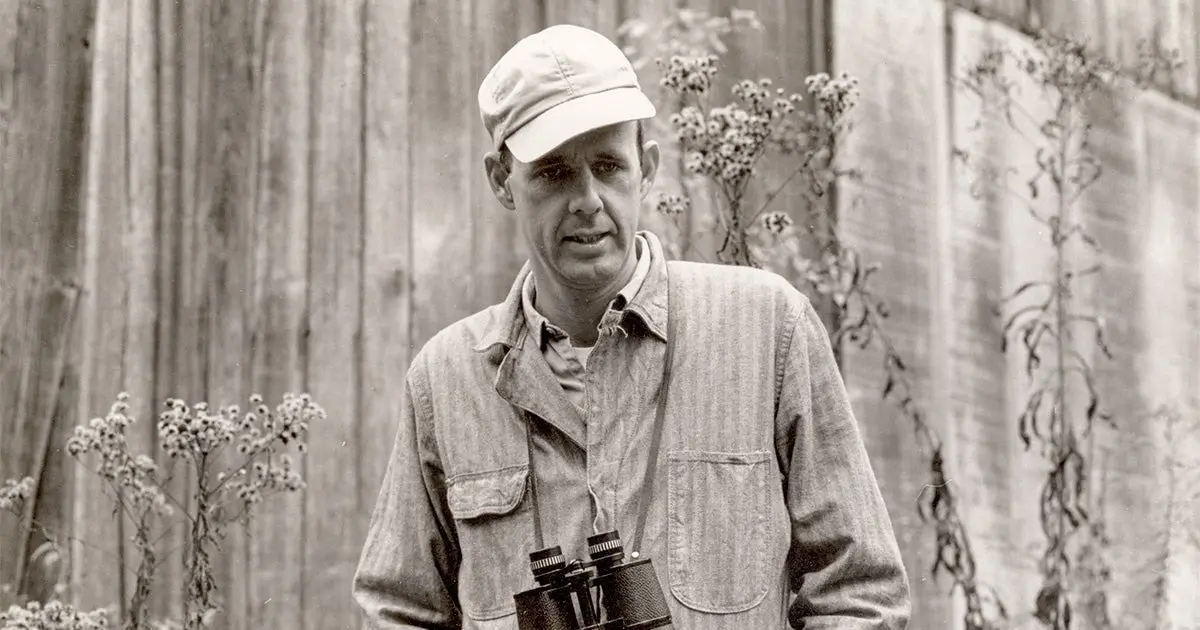

In the spring of 1971, amidst mounting bureaucratic momentum to dam and flood Kentucky’s ecologically fragile Red River Gorge, the distinguished essayist, novelist, and poet Wendell Berry published a defining critique of modern American land use. Originally featured in Audubon magazine and the University Press of Kentucky’s The Unforeseen Wilderness, Berry’s writing served as both an artistic meditation and an urgent political intervention. His advocacy against the proposed inundation helped galvanize a preservation movement that ultimately saved the gorge.
At its core, Berry’s thesis interrogates the psychological and mechanical barriers that distance humanity from the natural world. He posits that contemporary civilization operates within an insulated "mollusk-shell," a reflective, self-flattering enclosure that filters out raw reality in favor of preconceived, mechanical, and economic objectives. Whether through the tourist-photographer framing landscapes to match travel brochures, or industrial strip miners viewing earth solely through the lens of short-term market extractivism, humanity has historically approached the American continent as a ledger of transactional assets rather than a living, enduring home.
This investigative review examines Berry’s foundational arguments regarding ecological exploitation, the cultural pathology of seeking "easy wealth," the failure of purely aesthetic conservation, and the absolute necessity of shifting from a transactional economy to a long-term moral stewardship of the land.
Detailed Chronology and Historical Context
To understand the crisis of the Red River Gorge, Berry traced the cultural lineage of American environmental degradation back through centuries of westward migration, finding its prototype in Kentucky folklore: the legend of John Swift’s silver mine.
The Myth of John Swift and the American Impulse for Ease
- c. 1760: According to frontier legend, a man named John Swift wandered the Kentucky mountains, allegedly discovering a fabulously rich silver lode. He left behind a journal and map, but due to his poor cartographic skills, both proved completely meaningless.
- The Persistent Legend: Rather than fading, the meaninglessness of the map fueled an indefatigable dream. Generations of Kentuckians chose the nebulous, speculative pursuit of hidden wealth over the patient, grueling labor of cultivating the soil. Sites across the mountains—including Swift Camp Creek in the Red River Gorge—became littered with speculative excavations.
- The Forefather of Exploitation: Berry identified John Swift as the true intellectual forefather of European-American expansion in Kentucky. The settlers who followed poured through the mountain passes with minds fixed on quick riches—whether extracted from silver, coal, timber, or the soil itself through agricultural practices that treated farming like a mining operation, exhausting the land and giving nothing back.
The Institutionalization of Environmental Ruin
- Agricultural Imitative Failure: Moving westward, American farmers largely ignored local topography and soil constraints, mechanically imitating farming practices from their places of origin (Virginians copying Englishmen, Kentuckians copying Virginians). On steep Kentucky slopes, these inappropriate methods caused catastrophic erosion within mere years, whereas indigenous agricultural methods in Asia sustained productivity for six millennia.
- The Flight from the Land: Driven by a cultural fashion that prized urban life and equated manual labor with degradation, many farmers came to view their work as bondage. Their goal shifted from preserving the soil to accumulating enough capital to escape it. This ethos matured into the mechanized shortcuts of modern agribusiness.
- The Dam-Building Era: Decades of upstream overgrazing, poor row-cropping on steep ridges, and deforestation turned local tributaries into sediment-choked channels, driving cyclical downstream flooding. Rather than addressing the root cause of watershed degradation on the slopes, city leaders and the U.S. Army of Engineers deployed a single, abstract solution: building a dam to conquer nature once more.
Supporting Context & Metrics: Economics vs. Ecological Realities
Berry’s critique dismantles the economic rationalizations used by extractive industries, contrasting short-term financial metrics with the deep, unquantifiable value of ecological continuity.
+-------------------------------------------------------------------------+
|                  THE ECONOMIC VS. ECOLOGICAL PARADIGM                   |
+----------------------------------+--------------------------------------+
| Extractive / Short-Term Model    | Ecological / Long-Term Stewardship   |
+----------------------------------+--------------------------------------+
| • Mineral/timber market value    | • 6,000-year agricultural continuity |
| • Quick profits, immediate exit  | • Daily/seasonal yields & renewal    |
| • Abstract map-based planning    | • Direct physical labor & humility   |
| • Results: Erosion, silt, floods | • Results: Soil health, watershed stability|
+----------------------------------+--------------------------------------+
The Fallacy of Strip-Mining Mathematics
Industrial strip miners frequently justified the total destruction of surface ecologies by presenting financial calculations showing that the underground mineral wealth exceeded the market value of existing forests or crops. Berry exposed the fundamental flaw in this logic: it assumes that human dependence on the earth terminates the day after the coal seam is exhausted.
By contrast, historical evidence from sustainable agricultural systems in Asia demonstrates that soils managed with ecological wisdom can continuously feed populations for millennia. When measured across a six-thousand-year horizon, the sustained yield of a healthy landscape vastly outstrips the fleeting payday of a mined-out ridge.
The Mechanics of the "Clamshell" Economy
The American economic enclosure traps decision-makers within abstract ledgers, charts, and topographical projections. When public officials and engineers evaluate the Red River Gorge, they rely on water-level tables and projected tourism revenues, treating an irreplaceable river valley as a blank slate for economic stimulus.
However, stepping into the actual watershed reveals the physical consequences of this abstraction. Walking downstream on the Red River exposes a stream bottom choked in knee-deep mud—the eroded topsoil of mismanaged ridges upstream. Berry argued that putting a dam over such a watershed is as absurd as trying to plug a volcano; it treats a symptom while institutionalizing the disease.
Official Statements and Perspectives
The debate over the Red River Gorge encapsulates a broader ideological clash between institutional authorities, recreational consumers, and local stewards.
The U.S. Army of Engineers and Civic Proponents
- The Bureaucratic Response: Prompted by downstream cries of "flood control," the U.S. Army of Engineers relied on political barometers, maps, and cost-benefit ratios. To them, the gorge represented an ideal basin to impound water, generate recreational tourism, and manufacture an economic bonanza out of an ecological disaster.
- The Public Interest Justification: Government agencies framed the inundation as a sacrifice required for the "greater public good." Dispossessed families were compensated financially, reinforcing the bureaucratic assumption that monetary payouts fully resolve displacement.
The Scenery-Loving Public
- The Tourist Gaze: As the gorge gained fame from preservation efforts, weekend tourists arrived in bumper-to-bumper traffic, treating the wilderness as a packaged commodity. Their cameras and automobiles acted as censoring devices, seeking out pre-photographed scenic overlooks while remaining entirely blind to the intricate webs of life, death, growth, and decay surrounding them.
- The Illusion of Beautification: Scenery-oriented conservationists often reduced environmentalism to visual aesthetics—attempting to mask industrial scars with highway landscaping or fence laws around junkyards. Berry insisted that natural beauty is merely a by-product of natural health; an abused landscape cannot simply be "beautified" out of its ruin.
The Inhabitants and Artisans of the Land
- The Defiant Household: Deep within the wilderness sat a family home accessible only by footpath or tractor—a dwelling integrated into the literal and spiritual fabric of the gorge. For them, the home was not a temporary real estate asset, but a lifelong labor of love and ecological stewardship. Their potential eviction represented not a minor administrative relocation, but a symptom of a cancerous societal devaluation of life.
- The Vision of the Wilderness Photographer: Moving beyond the tourist, Berry framed the true environmental artist as a pilgrim who enters the landscape with profound humility, abandoning preconceived expectations to record the unscripted, inexhaustible manifestations of creation.
Future Outlook: Rebuilding the Connection to the Land
As Berry concluded decades ago—and as remains urgently true today—the preservation of the natural world cannot be accomplished solely through the political and legal maneuvers of conservation organizations. While institutional advocacy is vital, organizations alone cannot cultivate a genuine culture of care.
The Imperative of Localized Stewardship
- Rooted Communities: True environmental recovery requires individuals and families to establish a permanent, disciplined bond with specific places—living there, repairing past damages, rebuilding soil fertility, and respecting ecological limits.
- Rejecting the Culture of Escape: Society must move past the destructive quest for "easy wealth" and professional or geographic transience. Treating life as an endless migration from job to job destroys both family continuity and the mental discipline required to understand local ecosystems.
- Spiritual and Intellectual Clarity: The effort to save our environment must begin in the individual eye and mind. By casting aside the blinding preconceptions of industrial utility and economic abstraction, humanity can learn to see the world as it actually is—not as an inheritance to be squandered, but as a priceless loan borrowed from our children.