
Executive Overview
In the intricate theater of evolutionary biology, deception is a survival strategy executed with breathtaking precision. From orchids that impersonate female bees to fungi that mimic the scent of rotting flesh, flora has long bent the rules of sensory engagement to secure reproduction. Yet, until now, one major frontier of chemical mimicry remained entirely theoretical: the impersonation of ants.
That boundary has officially fallen. Researchers at the University of Tokyo have announced a groundbreaking discovery that expands our understanding of floral mimicry. Ko Mochizuki, a researcher at the university, has documented that Vincetoxicum nakaianum—a rare dogbane species native to Japan that was formally described by Mochizuki and his collaborators only a year ago—deploys an unprecedented olfactory disguise. The plant mimics the distinct, chemically complex scent profile of ants under attack by spiders.
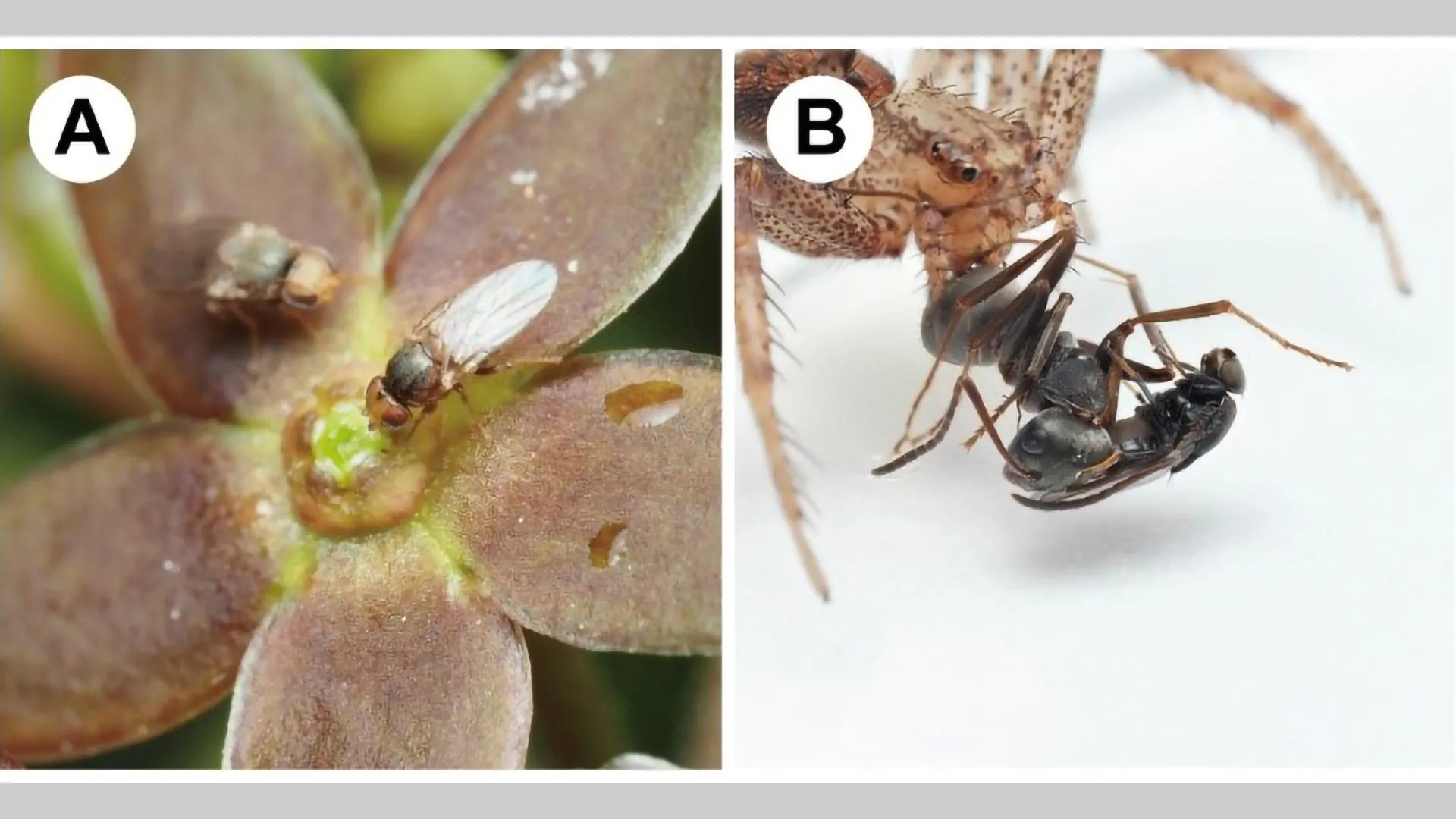
This pungent perfume acts as a siren song for grass flies (family Chloropidae), which feed on injured insects. As these duped flies swarm the Vincetoxicum nakaianum blossoms in search of a meal, they inadvertently transfer pollen from flower to flower, completing a remarkably macabre mutualism.
Published in the prestigious journal Current Biology, this finding marks the first scientifically documented case of a plant mimicking the odor of ants. By bridging the gap between chemical ecology, serendipitous field observation, and unconventional digital data collection, Mochizuki’s work shatters previous assumptions about the limits of floral mimicry. It suggests that the natural world still harbors masterclasses in deception waiting to be uncovered by the prepared observer.
Detailed Chronology: From Botanical Curio to Revolutionary Discovery
The Accidental Encounter at Koishikawa Botanical Gardens
Scientific breakthroughs are rarely born in sterile laboratories under the hum of fluorescent lights; more often, they are forged in the messy, unpredictable reality of the field. For Ko Mochizuki, the journey toward uncovering ant mimicry began entirely by accident.
Mochizuki was not initially looking for a new pollination system. He was deeply immersed in an entirely unrelated research project when he collected specimens of Vincetoxicum nakaianum. At the time, the plant was merely a botanical reference point—a comparative sample to be cataloged and filed away.
However, nature had other plans. While maintaining the specimens in a nursery at the University of Tokyo’s historic Koishikawa Botanical Gardens, Mochizuki noticed an anomalous gathering of small insects. Chloropid flies were persistently swarming the subtle, unassuming flowers of Vincetoxicum nakaianum.
Observing this hyper-specific aggregation, Mochizuki experienced a flash of scientific intuition. The congregation of flies was not random; it bore the hallmarks of a targeted ecological interaction. He immediately suspected that the flowers might be chemically imitating dead or dying insects to trick the flies into paying a visit.
Connecting the Dots: Training, Literature, and the Spark of Insight
What separates a casual observer from a visionary scientist is the mental architecture required to synthesize disparate clues. Mochizuki’s realization was the culmination of a very specific, seemingly unrelated set of prior experiences.
First, a rigorous intensive training course he had attended in 2019 provided him with the taxonomic expertise necessary to instantly recognize the exact fly species swarming the Vincetoxicum flowers. Without this specialized knowledge, the insects would have been dismissed as generic agricultural pests.
Second, Mochizuki happened to be deeply familiar with niche historical literature detailing plants pollinated by chloropid flies—studies noting that these particular insects were often drawn to flora emitting odors reminiscent of injured invertebrates.
Armed with this mental framework, Mochizuki formed a bold hypothesis: Vincetoxicum nakaianum was releasing an olfactory signature that tricked the flies into thinking an easy meal was waiting.
Methodical Fieldwork and the Digital Frontier
With a working hypothesis in hand, Mochizuki transitioned from passive observation to rigorous empirical testing. He initiated a methodical survey of the visitors frequenting the flowers, cataloging their behaviors and timings. Simultaneously, he began analyzing the volatile organic compounds—the odors—released by the Vincetoxicum blossoms, comparing them against the chemical profiles of various stressed and uninjured insects.
The chemical analysis yielded a compelling lead: the floral scent profile was an exceptionally close match to the chemical distress signals emitted by ants when they are captured and subdued by spiders.
Yet, a critical gap remained in the scientific literature. Mochizuki’s hypothesis rested on the premise that chloropid flies—or related species—naturally targeted ants hunted and injured by spiders in the wild. Surprisingly, no peer-reviewed ecological papers had ever formally documented this specific trophic interaction. His hypothesis, while chemically sound, was standing on frail empirical legs.
Refusing to let the absence of traditional academic literature halt his progress, Mochizuki turned to an unconventional research tool: social media.
Scouring public platforms, he tapped into a global network of amateur naturalists and macro-photographers. There, documented in high-resolution detail, was the exact ecological phenomenon he suspected: amateur naturalists across various regions had captured images and videos of ants being attacked by spiders, subsequently swarmed by kleptoparasitic flies looking to scavenge the spoils.
This crowdsourced validation provided Mochizuki with the empirical confidence he needed. He proceeded to design behavioral experiments, definitively proving that chloropid flies were significantly more attracted to the smell of spiders subduing ants than to a control array of other environmental odors.
Supporting Context & Metrics: The Ecology of Floral Deception
The Evolutionary Logic of Ant Mimicry
To understand the magnitude of Mochizuki’s discovery, one must examine the evolutionary pressures that govern plant-pollinator relationships.
Plants are sessile organisms; they cannot actively seek out mates or transport their genetic material across landscapes. Consequently, they must outsource reproduction to mobile intermediaries—insects, birds, and bats. While many plants reward their pollinators with high-energy nectar or protein-rich pollen, a significant subclass of flora has evolved the dark art of deceptive pollination. These plants offer no rewards, instead utilizing sexual, brood-site, or predatory mimicry to dupe visitors into providing free labor.
Ants represent one of the most ubiquitous and numerically dominant biomass groups on planet Earth. Because they are universally distributed and frequently engage in intense predatory or defensive conflicts with arthropods like spiders, they generate distinct chemical signatures. These signatures often involve alarm pheromones (such as formic acid or various hydrocarbons) released when the colony or individual is under severe duress.
Given that ant mimicry (myrmecomorphy) has independently evolved dozens of times among invertebrates—such as spiders, beetles, and bugs that disguise themselves as ants to evade predators or infiltrate colonies—evolutionary biologists long wondered why plants had not followed suit. Vincetoxicum nakaianum provides the definitive answer: they have.
Key Metrics of the Discovery
- Taxonomic Novelty: Vincetoxicum nakaianum was formally described to science only one year prior to this discovery by Mochizuki and his international collaborators, highlighting how much undiscovered biodiversity remains in plain sight.
- Evolutionary Milestone: This study marks the first time globally that a plant has been documented mimicking the odor profile of ants.
- Primary Pollinator Vector: Grass flies belonging to the family Chloropidae, known for their kleptoparasitic and scavenging habits regarding injured insects.
- Primary Odor Inspiration: The chemical cocktail released by ants undergoing active predation by arachnid (spider) predators.
- Publication Venue: The findings are officially peer-reviewed and published in Current Biology, signaling high academic consensus and impact within the ecological community.
Official Statements & Expert Perspectives
The discovery has sent ripples through the global botanical and entomological communities, challenging existing paradigms of how chemical ecology operates.
Reflecting on the moment his hypothesis crystallized, Ko Mochizuki shared a philosophical perspective on the nature of scientific inquiry:
"That moment, when I saw the flies on the flowers, was truly one of inspiration—a hypothesis suddenly taking shape. This experience taught me that unexpected discoveries often emerge from a combination of preparation and chance."
Mochizuki’s reflections underscore the reality of modern field biology: while high-tech gas chromatography and molecular assays are vital for confirming results, the initial spark still depends on the acute, observant eye of a researcher immersed in the natural world.
Colleagues and peer reviewers have lauded the study for its methodological creativity. By seamlessly blending classical botany, behavioral assays, organic chemistry, and digital citizen science, Mochizuki has established a new benchmark for investigating cryptic ecological interactions.
Furthermore, evolutionary ecologists note that this discovery forces a re-evaluation of how many other plant species might be employing sophisticated, highly specific forms of mimicry that evade human detection simply because we lack the sensory framework—or the historical botanical knowledge—to recognize them.
Future Outlook: Unlocking the Next Chapter of Floral Evolution
Science rarely concludes with a period; instead, every answer births a dozen new questions. Having successfully cracked the case of Vincetoxicum nakaianum, Ko Mochizuki is already casting his gaze toward the horizon, mapping out an ambitious agenda for future research.
Investigating Evolutionary Lineages and Genetics
Mochizuki’s immediate priority is to peel back the layers of evolutionary history that enabled Vincetoxicum nakaianum to develop this bizarre trait.
- Comparative Genomics: He plans to sequence and compare the genetic makeup of Vincetoxicum nakaianum with its closest phylogenetic relatives within the Vincetoxicum genus. By identifying genetic divergences, researchers can pinpoint the specific genomic pathways responsible for the biosynthesis of the spider-ant distress odor.
- Pollination Network Mapping: Comprehensive studies will be deployed across natural habitats to assess whether this ant-mimicry syndrome is utilized across multiple populations or if it varies depending on local spider and fly densities.
Broadening the Search for Hidden Mimicry
Perhaps the most exciting implication of Mochizuki’s work is the realization that Vincetoxicum nakaianum is likely not a lonely evolutionary outlier.
Because this study successfully uncovered a form of mimicry that previously hid in plain sight, Mochizuki intends to systematically explore other species—both within the vast Vincetoxicum genus and across entirely unrelated plant families. The natural world is rife with chemical signals, and it is entirely plausible that other flora have capitalized on the universal drama of insect predation.
As funding, technology, and interdisciplinary collaboration converge, the coming years promise to reveal an even richer, more complex tapestry of deception in the plant kingdom. Vincetoxicum nakaianum has opened a window into a hidden chemical battlefield—reminding humanity that in the wild, survival often depends on the most ingenious lies.