
Executive Overview
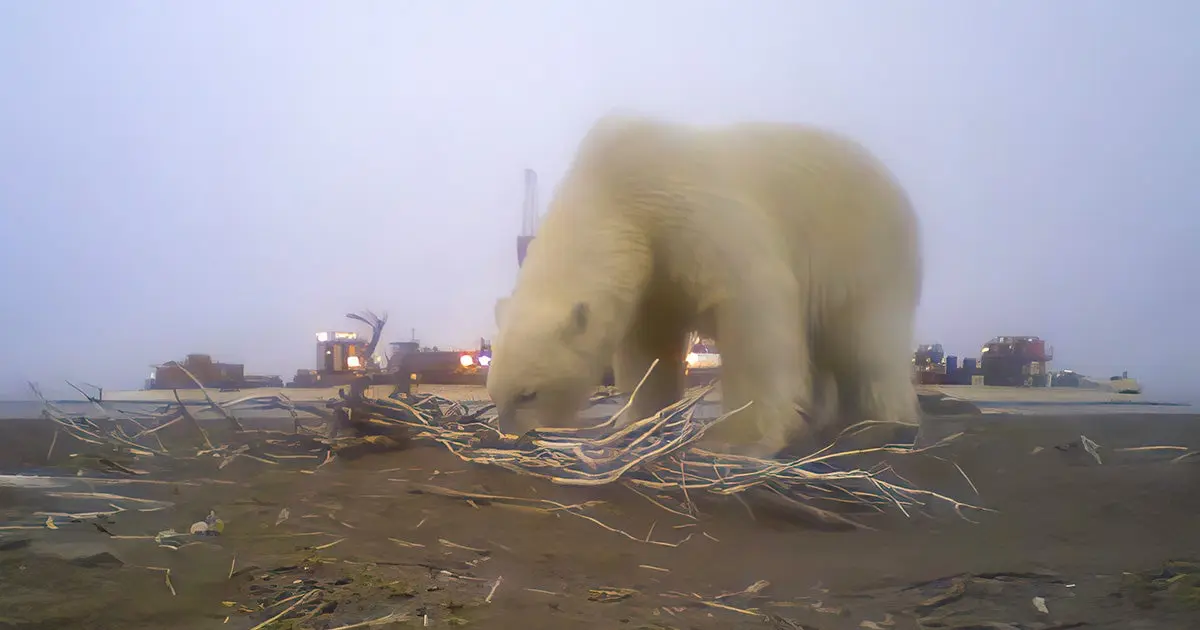
The rapid, climate-driven disappearance of Arctic sea ice is triggering a cascading ecological crisis across the polar north, fundamentally rewriting ancient predator-prey dynamics. According to a landmark scientific study recently published in the journal Polar Research, starving polar bears in Alaska are increasingly abandoning their historic marine hunting grounds to forage on land. Driven ashore by the loss of the summer sea ice platforms they rely on to hunt seals, these apex predators are decimating ground-nesting seabird colonies.
The research—co-authored by conservation ecologist Kayla Shively of the Wildlife Conservation Society (WCS) and ornithologist George Divoky, among others—provides the first documented evidence of large-scale, systematic bear-bird predation in Alaska. Documenting a trend previously observed in localized regions of Canada, Svalbard, and Greenland, the new findings confirm that polar bears are now systematically raiding the nests of Pacific Common Eiders and Black Guillemots along Alaska’s northern coast.
While individual seabird species face an immediate, catastrophic threat to their reproductive success—with some colonies suffering total breeding failures—experts emphasize that the phenomenon is symptomatic of a much deeper, systemic environmental collapse. The vanishing sea ice does not merely force polar bears ashore; it initiates a destructive trophic cascade that threatens the fragile interconnected webs of high-latitude marine and terrestrial ecosystems. As scientists project a grim future for both the region’s beleaguered seabirds and its rapidly declining polar bear populations, the crisis underscores the urgent need for global climate action to curb the fossil fuel emissions driving Arctic warming.
Detailed Chronology: A Crisis Unfolding on the Tundra
The transformation of Alaska’s barrier islands from secure avian nurseries into active foraging grounds for hungry polar bears has accelerated dramatically over the past two decades. Historically, these remote spits of low tundra and gravelly shorelines served as safe havens for breeding seabirds, largely protected from traditional mammalian predators like Arctic foxes. Summer sea ice historically kept polar bears far offshore, focused on the ice floes where ringed and bearded seals thrived.
However, the modern era has seen a dramatic shift in this delicate geography. Over the past 20 years, as summer sea ice has melted away at unprecedented rates, the presence of polar bears along Alaska’s north coast has multiplied sixfold. This geographical overlap between displaced predators and dense avian nesting colonies has set the stage for ecological devastation.
The Cooper Island Black Guillemot Collapse
The unfolding crisis is starkly illustrated on Cooper Island, a small, gravelly outcrop in the Beaufort Sea that has long served as the summer home for Mandt’s Black Guillemots, a distinct Arctic subspecies. These birds initially established their nesting grounds under military debris—such as wooden planks and ammunition boxes—left behind by the U.S. Navy following the Korean War.
When ornithologist George Divoky began monitoring the colony in 1975, polar bear visitations were exceptionally rare, and predation on the guillemots was virtually non-existent. For decades, the colony faced typical natural pressures, but the situation deteriorated radically in the late 2000s. During the breeding seasons from 2008 through 2010, marauding bears killed nearly half of all nestlings on the island.
In a desperate bid to save the colony, researchers installed bear-proof artificial nest cases on the island in 2011. Yet, the adaptability of the starving bears proved formidable. Over subsequent seasons, individual bears learned how to break open the fortified cases, and in some instances, even submerged them in water to flush out the adult birds hiding inside. By the breeding seasons of 2024 and 2025, the relentless pressure culminated in complete reproductive failure for the Cooper Island guillemots.
The Spy Island Eider Devastation
Farther east along the Beaufort Sea coast, a parallel drama has played out on Spy Island. Here, Pacific Common Eiders—the largest sea ducks in the Northern Hemisphere—nest amidst driftwood, sparse tundra vegetation, and low dune ridges. Female eiders invest immense biological energy into reproduction, spending a greater proportion of time directly on their nests than any other waterfowl species, rendering them stationary and highly vulnerable targets.
For decades following the inception of modern ecological surveys in the 1970s, reports of bear predation at Spy Island were sparse. The turning point arrived during the summers of 2016 and 2017, when foraging bears destroyed 11 percent of the island’s monitored nests.
The crisis reached a chilling apex on a single summer day in 2024. Conservation ecologist Kayla Shively and her WCS team arrived at the Spy Island nesting colony to an eerie silence. "When we arrived, it was very quiet," Shively recalls. "No adult females remained on the island. We started noticing scat, crushed eggshells, and bear tracks zigzagging from nest to nest." In less than 24 hours, a single polar bear had systematically destroyed 89 percent of the nests, wiping out a vital segment of the local population.
Supporting Context & Metrics: The Mathematics of Hunger
To understand why polar bears are systematically raiding bird colonies despite the low caloric return, scientists must examine the harsh energetic realities of life in a warming Arctic.
Energetic Imbalance: Eggs Versus Seals
Polar bears are hyper-carnivorous marine mammals evolutionarily optimized for a high-fat diet of marine mammal blubber. Seabird eggs and nestlings, while rich in protein, cannot sustainably replace seal blubber.
Biological models highlight the steep energetic deficit bears face when relying on avian prey:
- Daily Caloric Requirements: An adult polar bear requires massive daily caloric intake to maintain its basal metabolic rate and body condition.
- The Eider Egg Threshold: Scientific assessments indicate that a single adult polar bear requires approximately 54 Common Eider eggs to meet its basic daily energy requirement.
- The Spy Island Toll: During the single-day raiding event on Spy Island in 2024, the rogue bear consumed an estimated 255 eggs.
While consuming 255 eggs is an extraordinary foraging feat, researchers note that this caloric bounty is roughly equivalent to just a single yearling ringed seal—providing enough energy to sustain the massive predator for less than five days. Consequently, avian predation is not a long-term nutritional solution for the bears, but rather a desperate behavioral adaptation born of starvation as sea ice disappears.
The Broader Trophic Cascade
The removal of sea ice acts as a structural fracture rippling through the entire Arctic food web. While ground-nesting eiders and guillemots suffer heavy mortality directly from bears, other wildlife species are inextricably linked to the hunting success of polar bears on the ice.
Historically, when polar bears successfully hunted seals on the ice floes, they left behind scraps of meat and blubber. This carrion served as a critical food source for a suite of scavenging Arctic species, including Ivory Gulls, Rough-legged Hawks, and Snowy Owls. As sea ice vanishes and bears shift their hunting efforts to land-based avian colonies, these scavenger populations are simultaneously deprived of their traditional marine food subsidies.
"There’s a whole trophic cascade that comes from taking sea ice out of an ecosystem," notes University of Alberta biologist Andrew Derocher. "That system is fragile, and deeply interconnected."
Official Statements and Expert Perspectives
The publication of the new research in Polar Research has drawn widespread commentary from leading polar ecologists, ornithologists, and conservation scientists, highlighting the multi-layered implications of the crisis.
-
Kayla Shively, Conservation Ecologist, Wildlife Conservation Society:
Reflecting on the discovery at Spy Island, Shively emphasizes the alarming shift in predator behavior: "When we arrived, it was very quiet. No adult females remained on the island. We started noticing scat, crushed eggshells, and bear tracks zigzagging from nest to nest… On these small islands, one or two polar bears can devastate an entire colony." Addressing the compounding environmental pressures on the north coast, she adds: "In northern Alaska, [shoreline erosion and flooding driven by sea ice loss] is the greatest threat to Pacific Common Eiders." -
Don Lyons, Director of Conservation Science, Audubon’s Seabird Institute:
Providing perspective on the long-term viability of Arctic bird populations, Lyons notes that while the immediate predation is severe, the ultimate threats are cumulative: "Most seabird species in the Arctic are still in relatively good shape. They’re not at risk of extinction in the next 50 years. But they’re going to face real challenges, and could become endangered in that time frame." Urging a focus on systemic roots, Lyons stresses: "We can’t lose sight of the big picture: Taking climate action at a global scale. Each year, sea ice loss is directly proportional to human-caused fossil fuel emissions. For bears and birds alike, the future is uncertain. The cause of that uncertainty, and its solutions, are not." -
Andrew Derocher, Biologist, University of Alberta:
Offering a sobering prognosis for the regional apex predators, Derocher contrasts the fate of Alaskan polar bears with populations elsewhere in the Arctic: "Elsewhere in the Arctic, bears are less vulnerable to sea ice decline, and are learning to hunt species like reindeer and walrus. But in the southern Beaufort Sea, the population is hanging on by a claw. In 50 years, I don’t think we’ll have polar bears here."
Future Outlook: A Race Against Time
As the scientific community digests the findings of the Polar Research study, the trajectory for both Arctic seabirds and polar bears points toward an increasingly precarious future.
For the ground-nesting seabirds of Alaska’s barrier islands, the coming decades will present a brutal double bind. On one hand, persistent and adaptive predation by stranded polar bears threatens to drive local nesting colonies—such as the Black Guillemots of Cooper Island—to functional extinction. On the other hand, the exact same climatic forces melting the sea ice are supercharging coastal vulnerability. Accelerated shoreline erosion, rising sea levels, and increasingly violent storm surges driven by open-water fetches are actively drowning and washing away the low-lying tundra and gravel spits where eiders lay their eggs.
For the polar bears of the southern Beaufort Sea, the outlook is even more existential. Trapped between the loss of their marine hunting platform and an inadequate terrestrial diet of bird eggs and vegetation, their populations are running out of time. Biologists agree that seabird predation cannot sustain a polar bear population over evolutionary time scales; it is merely a symptom of a dying ecosystem.
Ultimately, researchers emphasize that treating the symptoms—such as installing bear-proof nesting boxes or attempting to manage localized predator-prey conflicts—will offer only temporary reprieves. The survival of the Arctic’s iconic megafauna and its resilient seabird communities remains inextricably tethered to global commitments to drastically reduce greenhouse gas emissions and halt the warming of the planet. Until humanity addresses the root cause of Arctic sea ice loss, the silence on islands like Spy Island and Cooper Island will serve as an ominous preview of a profoundly altered northern world.